By: Marshall Bursis
Frank Capra’s 1946 film It’s a Wonderful Life has become a Christmas classic. However, the story of George Bailey and the community of Bedford Falls resonates outside the movie’s holiday context.
For an American classic, the film’s emphasis on community is strange. George Bailey—president of the local Bailey Building and Loan—lacks the adventurism and individuality of the protagonists of popular Cowboy Westerns. Bedford Falls, the movie’s fictionalized small-town, hardly matches the excitement and drama typical of Hollywood’s golden era. The story is unique in an American culture saturated with a spirit of meritocracy and individualism.
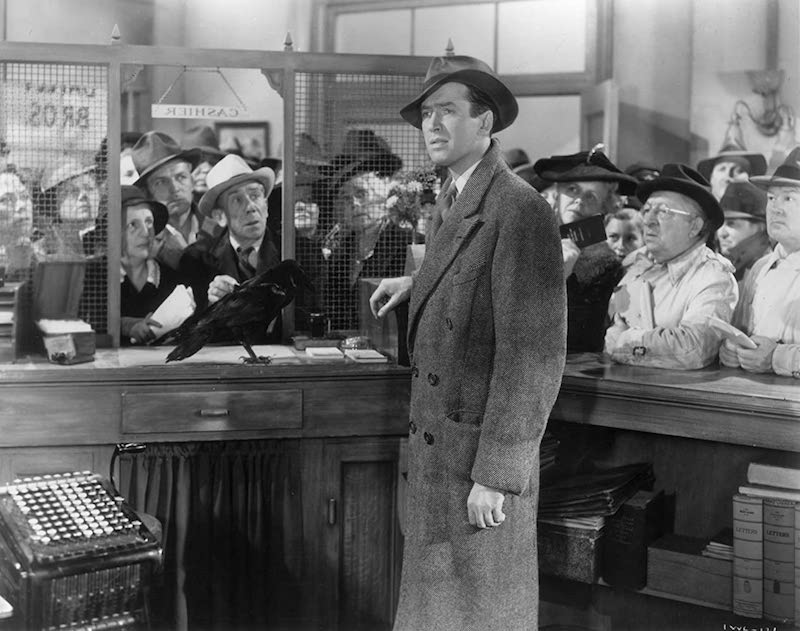
It’s a Wonderful Life begins with a close-up of a sign reading, “You are Now in Bedford Falls.” The town and its community are fundamental to the narrative of George’s life that follows. The movie introduces George as a bright, ambitious young man with plans to travel the world and leave Bedford Falls for college and a career as an architect. Yet, at each of the film’s critical moments, George sacrifices personal ambition for the health of his family and town. Most dramatically, minutes before leaving town for his honeymoon, the Building and Loan experiences a depression-era bank run. George pleads with the townsfolk to temper their panic and urges them to recognize the interconnectedness of the community. The money the depositors demand is not, he tries to explain, in the bank’s vault. Rather than locked in a safe, “[their] money’s in Joe’s house… and in the Kennedy house, and Mrs. Macklin’s house, and a hundred others.” When certain depositors refuse, George loans the money set aside for his honeymoon at no interest to save residents of the town from foreclosure.
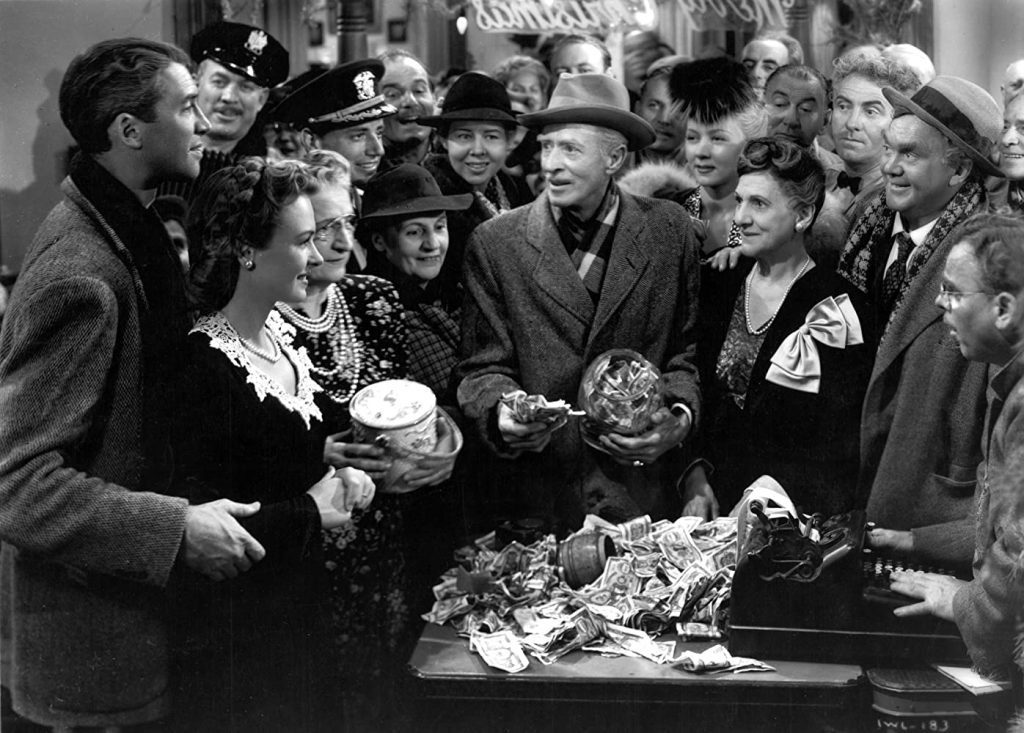
Importantly though, George is not only the savior of his community. When his absentminded uncle loses $8,000 ahead of the building and loan’s yearly audit, the community of Bedford Falls ultimately protects George from accusations of bank fraud and arrest. Mary, his wife, rallies the community behind George. She and Uncle Billy run into the house with money they have gathered from the citizens of Bedford Falls. More and more people from the town file into their house, each giving George more and more money until it becomes clear they have raised the $8,000 George needs. Earlier, Mr. Potter warns George that the community would turn away from him in his time of need. Instead, they redeem him.
The happily-ever-after ending of It’s a Wonderful Life may seem overly sentimental to postmodern audiences, but the film’s themes are increasingly relevant in a contemporary society overwhelmed by a feeling of isolation. In the 1980s, only twenty percent of Americans surveyed claimed they often felt lonely; today, forty percent say the same. At the start of 2018, the United Kingdom appointed a Minister for Loneliness. Political scientist Robert Putnam first noticed this alarming trend in his 1995 article “Bowling Alone.” He documented the drastic decline in membership in social organizations and most famously found that the number of bowlers had increased by ten percent between 1980 and 1993, yet membership in bowling leagues decreased by forty percent. The consequences of this growing social isolation are deadly. Loneliness has similar health effects to smoking fifteen cigarettes a day. Furthermore, in America alone, 45,000 people commit suicide annually and another 70,000 will die from drug overdoses.
Recently, columnist David Brooks has warned against the corrosiveness of our culture’s meritocratic careerism. Contrary to popular myths of mobility and career success, Brooks argues that those who root themselves in one community lead the most fulfilling lives. “It’s the chains we choose,” he says, “that set us free.” The tragedy of Leo Tolstoy’s The Death of Ivan Ilyich is that its protagonist only learns the hollowness of achievement-centered, hyper-individualism shortly before his death. Ivan, a high court judge steeped in a bureaucratic culture of work and promotion, realizes while near death that “his professional duties and the whole arrangement of his life… might all have been false.” While he advanced professionally, he admits that “life was ebbing away from me.”
The world desperately needs more stories of community. The sense of belonging depicted in It’s a Wonderful Life recognizes the immutable desire of human nature toward community and meaningful relationships. The film’s postscript summarizes its communitarian ethos: “No man is a failure who has friends.” It’s a Wonderful Life offers an antidote to the perverse implications of a collective meritocratic culture that defines a person’s worth through their accomplishments. It is also a prescription for a better, more full life.
References
Arthur Brooks, “How Loneliness Is Tearing America Apart,” https://www.nytimes.com/2018/11/23/opinion/loneliness-political-polarization.html.
Ceylan Yeginsu, “U.K. Appoints a Minister for Loneliness,” https://www.nytimes.com/2018/01/17/world/europe/uk-britain-loneliness.html.
David Brooks, “Five Lies Our Culture Tells,” https://www.nytimes.com/2019/04/15/opinion/cultural-revolution-meritocracy.html.
David Brooks, “The Blindness of Social Wealth,” https://www.nytimes.com/2018/04/16/opinion/facebook-social-wealth.html.
It’s a Wonderful Life, Directed by Frank Capra, RKO Radio Pictures, https://vimeo.com/280022699.
Leo Tolstoy, The Death of Ivan Ilyich, https://www.lonestar.edu/departments/english/Tolstoy_Ivan.pdf.
Robert Putnam, “Bowling Alone: America’s Declining Social Capital,” Journal of Democracy.
 New Frontier