
By: Marshall Bursis
The most compelling argument for Joe Biden’s candidacy is not his 36 years of legislative experience in the U.S. Senate, nor is it his eight years of executive experience as Vice President. It is also not his prevailing centrism and commitment to compromise in an era of hyper-polarization and gridlock. Biden’s greatest qualification is his most human—his empathy.
Suffering and struggle are not abstractions for Biden. He has experienced profound loss twice in his life—first losing his first wife and 1-year old daughter in a 1972 car accident, then losing his son Beau to brain cancer in 2015. Recently covered but less known is that Biden struggled—and continues to struggle—with a stutter. He is also a child of the working class. Economic hardship forced his family to sell his childhood home and move in with his maternal grandparents in Scranton before his father took the family to Delaware in search of steady employment.
In Biden’s public discussions of this biography, his empathy, purpose, and qualification for president become clear.
In a long interview with the Des Moines Register in December 2019, Biden answered questions about his efforts to console voters who have experienced the untimely death of children and close relatives. Recognizing that he himself benefited from similar support, Biden notes that “the only people who can allay people’s concerns is someone who went through it.” But Biden is quick to deflect from his own experience to emphasis the extreme loss and resilience of those he meets. These individuals, Biden stresses, “get up and face the most horrible things… I mean they’re real heroes.” In a similar interview with Stephen Colbert from 2015 discussing his son Beau, Biden repeats a similar message: “there’s so many people… who have had losses as severe or worse than mine and didn’t have the incredible support I have. I have such an incredible family. I feel self-conscious.”
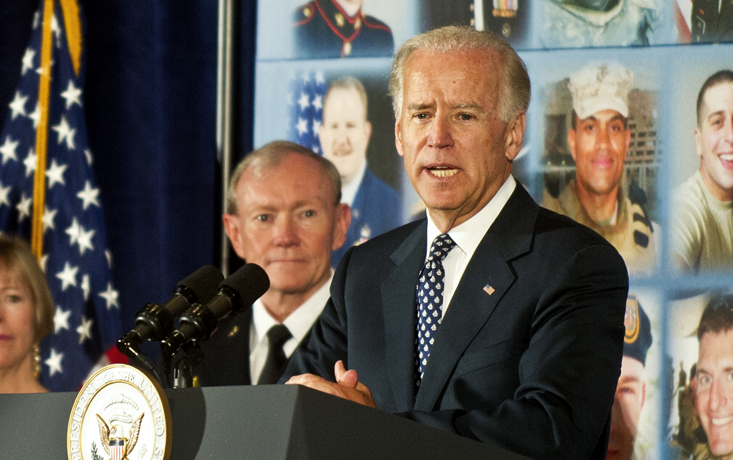
What makes Biden’s public discussion of hardship so compelling, though, is that he does not pretend to have suffered at all times with grace. Biden is perhaps his most vulnerable in a speech on grief before families of fallen soldiers in 2012. Remembering the day that his first wife and daughter died, he tells the crowd, “I was angry… I was mad at God.” In a moment of intense transparency, Biden subtly confides in his audience that he had contemplated suicide, saying he “understood how someone could consciously decide to commit suicide.” In that same interview from 2015 with Colbert, when urged by Colbert to enter the 2016 campaign, Biden confessed he was still debilitated by grief for Beau. He expresses frustration with a voter who shouted his deceased son’s name during a rope-line, painfully reminding Biden of his loss. “Sometimes it just sort of overwhelms you,” Biden acknowledges.
The Christian theologian Augustine, writing on the existence of sorrow, remarked that, “it is not the kind of suffering but the kind of person who suffers that is so important.” Biden understands this deeply. Asked at a town hall about racial reconciliation by Rev. Anthony Thompson, the husband of one of the 9 victims of the Charleston AME Church Shooting, Biden praised the response of the victims’ families. Their forgiveness of the shooter, “the ultimate act of Christian charity,” Biden says, helped heal the state. “You brought down that Confederate flag,” Biden tells the Reverend. “You changed the attitude in this state in a way that was profound.”
Biden, likewise, has transformed his suffering into purpose. Rather than make him callous, Biden’s personal struggles have enabled him to more viscerally know the pain of others. It is a personal story that has uniquely qualified Biden to lead a nation ravaged by death and economic hardship. When Biden speaks of grief, he does so from the experience of a husband who predeceased his first wife and a father who buried two children. When Biden speaks of economic pain, he does so from the perspective of a child in a family that struggled with unemployment and felt acute financial insecurity. When he denounces Trump’s bully-like behavior, he does so with the memory of the humiliation felt by a schoolboy targeted by teachers and friends for his stutter.
Biden will restore empathy to the executive and to the government of a nation desperately in need of a leader who personally knows its struggles.
References
Augustine, Political Writings, edited by Michael W. Tkacz et al.
“Joe Biden shares story of faith with pastor who lost his wife in Charleston shooting,” https://www.youtube.com/watch?v=81bzoO9Qy9A.
John Hendrickson, “What Joe Biden Can’t Bring Himself to Say,” https://www.theatlantic.com/magazine/archive/2020/01/joe-biden-stutter-profile/602401/.
Speech by Vice President Biden, “Vice President Biden Discusses Grief at TAPS,” https://www.youtube.com/watch?v=GwZ6UfXm410&t=496s.
Stephen Colbert interviews Joe Biden, “Vice President Joe Biden Interview, Part 1,” https://www.youtube.com/watch?v=opVaEC_WxWs.
Stephen Gruber-Miller interviews Joe Biden for the Des Moines Register, “Full interview: Joe Biden talks grief in Iowa,” https://www.youtube.com/watch?v=fry_zm31BKQ.
 New Frontier