By: Marshall Bursis
The inability of the current Democratic coalition to raise revenue poses a fundamental problem for the future of center-left politics in America. New York Times editorial board member Binyamin Appelbaum has written that “resistance to taxation is the rotten core of the modern Republican Party.” But, recent legislative negotiations over the Biden administration’s social spending package have displayed a similarly troubling distaste among some Democrats—not towards taxation itself, but for the prospect that their increasingly rich constituents might be among those asked to pay.
As Democrats neared finalizing their spending and tax package, Senator Kirsten Sinema (D-AZ) announced her opposition to any rate increases on corporate taxes, top marginal income taxes, and capital gains. Instead, the White House landed on a far narrower tax increase—a surtax that affects those making more than $10 million, the top 0.02% of income earners. According to 2018 IRS data, this increase will affect only 26,517 households. The resulting loss of revenue has reduced the scope of the spending package from $3.5 trillion to $1.75 trillion—forcing Democrats to cut paid leave, expanded Medicare benefits, universal community college tuition, and other priorities.
Some Democrats, though, would like a further tax cut for some of America’s highest income earners. A group of House moderates—led by Rep. Josh Gottheimer (D-NJ), Rep. Tom Suozzi (D-NY), Rep. Mikie Sherrill (D-NJ), and Rep. Bill Pascrell (D-NJ)—have said that they won’t support the larger spending package without a repeal of a limit on state and local tax deductions, referred to as the SALT deduction. Richard Reeves of the Brookings Institute has called the deduction a “politically-motivated handout to the richest people in the richest places.” According to his research:
Almost all (96 percent) of the benefits of SALT cap repeal would go to the top quintile (giving an average tax cut of $2,640); 57 percent would benefit the top one percent (a cut of $33,100); and 25 percent would benefit the top 0.1 percent (for an average tax cut of nearly $145,000). The remaining four percent of the benefit of removing the cap would go the middle class (i.e. middle 60 percent), for an average annual tax cut of a little less than $27.
Now, after the latest framework agreement from the White House left out a repeal of the SALT cap, Rep. Tom Suozzi tweeted “No SALT, no deal!”
Democrats representing high-income constituencies in high-tax cities and states have largely campaigned for the limit’s repeal, despite the lop-sided benefits to the rich. Senate Majority Leader Chuck Schumer (D-NY) opposes the cap and has called it “a tax increase for many middle-class families.” Except for House Speaker Nancy Pelosi, the entire California Congressional delegation sent a letter to President Biden in April lobbying for a repeal of the cap—a group that includes House Progressive Caucus Deputy Chair Rep. Katie Porter and members Rep. Ro Khanna and Rep. Jimmy Gomez.
Democrats are having these debates in a warped environment where the term “middle class” has lost all meaning. President Biden has himself pledged to only increase the taxes of households making more than $400,000—a group comprising the top one or two percent of households by income. It is not surprising that a political party that has added wealthy suburbanites and college-educated professionals to its coalition would develop taxphobia. Educational polarization has made the Democratic constituency much richer on average. As a result, Democrats have developed a pathology of pointing further up the ladder of the income distribution in policy debates about inequality and taxation.
After blocking more conventional tax increases on America’s 1%, Sen. Sinema backed a dubious proposal from Senator Ron Wyden (D-OR) that would tax the unrealized wealth of America’s roughly 700 billionaires. Rep. Alexandria Ocasio-Cortez (D-NY) defended herself from criticism for wearing a dress emblazoned with “tax the rich” to the Met Gala by saying that she and her peers were themselves not rich. “They want you to think that when we talk about rich, we’re talking about a doctor or a lawyer,” she said, “instead of someone with hundreds of millions of dollars if not billions of dollars.” “That’s what we mean by rich,” she added. In this calculation, only a few thousand households are the object of her sartorial slogan.
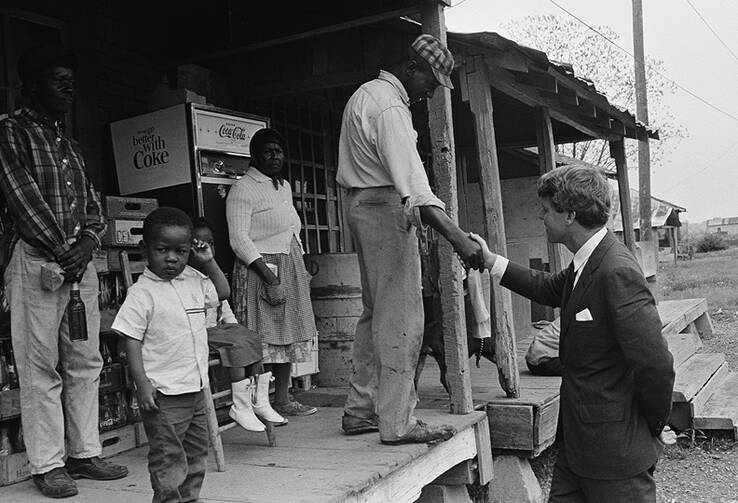
Appelbaum is right that the Republican Party, despite its outwardly populist turn, remains ideologically opposed to taxation. But, an increasingly affluent Democratic coalition appears to be a threat to the redistributionist impulses of the New Deal and Great Society. Then-Senator Robert Kennedy, campaigning for the 1968 Democratic Presidential nomination, asked an audience of college students to think of the “other America”—those afflicted by poverty, hunger, and material deprivation. Generous social welfare programs require broad tax bases. Should the Democratic Party want to retain its identity as the party of the working-class, its leaders will need to ask more of their constituents.
 New Frontier