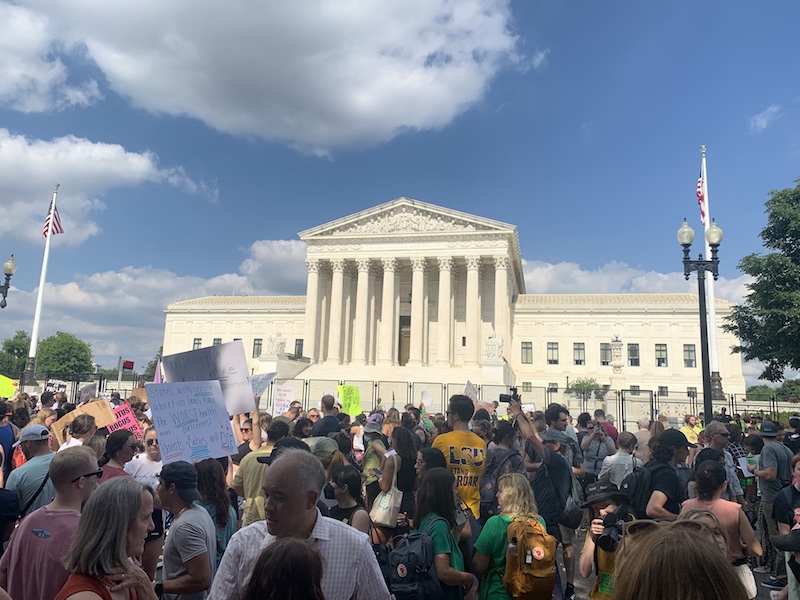
Yesterday, on June 24, 2022, the Supreme Court issued a landmark decision rejecting women’s abortion rights under the Constitution and overturning Roe v. Wade (1973) and Planned Parenthood v. Casey (1992). Discarding fifty years of Supreme Court doctrine, the decision reshapes American abortion jurisprudence. It has ignited celebration among conservatives, despair among liberals, and protests across the nation.
Questions abound. What exactly did the Court rule, and what reasons did it give? Most importantly, what does this ruling mean for the future of abortion in America, and for other constitutional rights like contraception and same-sex marriage?
I saw that the Supreme Court overturned Roe v. Wade. What exactly happened?
In Dobbs v. Jackson Women’s Health Organization, the Supreme Court considered the constitutionality of a 2018 Mississippi law banning abortion at 15 weeks.
The Court upheld the constitutionality of the law. In doing so, a 5-justice majority overturned two previous landmark abortion decisions, Roe and Casey.
This decision is a landmark of landmarks. It’s arguably the most consequential Supreme Court ruling of the 21st century, and the most important abortion decision since 1992. It’s the judgment of a new conservative majority on the Court, one more committed than ever before to originalism and readier than ever before to jettison precedents inconsistent with its originalist vision.
Which justices voted for what?
The decision was 5-1-3. It was 6-3 to uphold the Mississippi law, and 5-4 to overturn Roe and Casey.
The five most conservative justices — Justices Samuel Alito, Clarence Thomas, Neil Gorsuch, Brett Kavanaugh, and Amy Coney Barrett — voted to uphold the Mississippi law and overturn Roe and Casey. Justice Alito wrote the majority opinion, and Justices Thomas and Kavanaugh filed highly significant concurring opinions.
Chief Justice John Roberts, the lone wolf, voted to uphold the Mississippi law but preserve Roe and Casey. He did not join Justice Alito’s majority opinion. Instead, he filed a separate opinion.
The Chief Justice tried to stake out a compromise position that would’ve saved Roe and Casey. To succeed, he needed the vote of at least one of the other five conservatives. This probably would’ve been Justice Kavanaugh, who’s the swing justice, but he didn’t bite.
That leaves the three liberal justices, Justices Stephen Breyer, Sonia Sotomayor, and Elena Kagan. They voted to strike down the law as unconstitutional and keep Roe and Casey, and they filed a joint dissenting opinion. (Side note: This is Justice Breyer’s last term. He’ll soon be replaced by Ketanji Brown Jackson.)
What was the state of abortion law under Roe and Casey?
Before Dobbs, when Roe and Casey were governing law, states couldn’t ban abortion before fetal viability, the point at which the human fetus can survive outside the uterus, around 24 weeks after the woman’s last menstrual period.
States could regulate abortion before viability (through measures like informed consent, mandatory waiting periods, and parental consent, as long as they didn’t impose an “undue burden” on women’s ability to get abortions). But they couldn’t outright ban abortion until viability.
What’s the state of abortion law now?
There’s a short answer, and a long answer.
The short answer: With Roe and Casey behind us, with Dobbs as governing law, women no longer have a constitutional right to abortion. State legislatures can ban abortion at any time, whether pre-viability or post-viability, starting from the moment of fertilization.
Mississippi’s 15-week ban is constitutional. So are the “trigger laws” of 13 states — laws that stayed on the statute books, dormant under Roe and Casey but brought back to life by Dobbs — that ban abortion completely. (These states are Arkansas, Idaho, Kentucky, Louisiana, Mississippi, Missouri, North Dakota, Oklahoma, South Dakota, Tennessee, Texas, Utah, and Wyoming.) Either these laws have already gone into effect, or they will soon.
The red states that haven’t already banned abortion, will. Overall, analysts expect abortion to be banned in around 25 states, home to 36 million women. Some of these bans will be challenged in state courts as violating state constitutions.
Blue states will either keep the abortion laws they currently have or strengthen protections for abortion rights.
Congress may also now be able to ban abortion nationwide. This won’t happen while Democrats control Congress, as they do now, but when Republicans eventually retake control of Washington, it may. (Congress may also still have the option, as it did before Dobbs, to protect abortion nationwide by passing a law codifying Roe and Casey.)
The long answer is: There are a whole set of open questions about what this ruling means for abortion rights, as well as contraception and LGBTQ rights. More on that in a moment.
What were the conservative majority’s reasons for overturning Roe and Casey?
In a nutshell: Abortion rights have no basis in the text, history, or tradition of the Constitution. “The Constitution makes no reference to abortion, and no such right is implicitly protected by any constitutional provision.” So the Court should “return the issue of abortion to the people’s elected representatives.”
Roe and Casey found abortion to be protected by the 14th Amendment’s Due Process Clause, which prohibits states from “depriv[ing] any person of life, liberty, or property, without due process of law.”
But in and around 1868, when the 14th Amendment was ratified, many states criminalized abortion. And in 1973, when Roe was decided, 30 out of 50 states still banned abortion. So, Justice Alito argued in his majority opinion, there’s no constitutional tradition of abortion rights in America.
If, he contended, both before and after the 14th Amendment was ratified, states kept outlawing abortion, and if no court until the Roe Court ever thought to strike down these laws as unconstitutional, then clearly the people who framed, ratified, and lived under the 14th Amendment didn’t think it protected the “liberty” of women to get abortions. “The inescapable conclusion is that a right to abortion is not deeply rooted in the Nation’s history and traditions.”
Nor, Justice Alito ruled, do abortion bans discriminate against women. Government “regulation of abortion is not a sex-based classification,” so such regulations don’t violate the 14th Amendment’s Equal Protection Clause.
This makes Roe and Casey, which recognized a constitutional right to abortion, “egregiously wrong.” As a result, “Roe and Casey must be overruled.”
The argument on the other side, which the liberals forcefully made in their joint dissent, is that using 1868 as an anchor for tradition is illegitimate because women weren’t treated as equals to men in 1868. Women didn’t even win the right to vote until 1920, with the ratification of the 19th Amendment. “Those responsible for the original Constitution, including the Fourteenth Amendment, did not perceive women as equals, and did not recognize women’s rights. When the majority says that we must read our foundational charter as viewed at the time of ratification…, it consigns women to second-class citizenship.”
Under Dobbs, will abortion bans need to have exceptions for rape or incest?
No. The Mississippi law at issue has no exceptions for rape or incest, and the Court still found it constitutional.
The liberals wrote in dissent: “[A] woman will have to bear her rapist’s child or a young girl her father’s—no matter if doing so will destroy her life.”
Will abortion bans need to have exceptions for fetal abnormalities?
Maybe, maybe not. The Mississippi law at issue does have a fetal abnormalities exception, but Justice Alito never said that constitutional law requires this exception.
The liberals wrote: “[A]fter today’s ruling, some States may compel women to carry to term a fetus with severe physical anomalies—for example, one afflicted with Tay-Sachs disease, sure to die within a few years of birth.”
Will abortion bans need to have exceptions for maternal health?
Maybe — I’d say probably. Like with fetal abnormality exceptions, the Mississippi law has a “medical emergency” exception, but Justice Alito didn’t say if that exception is required.
But Justice Kavanaugh’s concurrence strongly hints that it will be required. (A concurring opinion is a separate opinion written by a justice in the majority, elaborating on the Court’s decision or providing different or additional reasons for it.) Remember, Justice Kavanaugh is the swing justice, so his concurrences are really important. When the justices vote along ideological lines, whichever side gets Justice Kavanaugh’s vote will win.
In a footnote in his concurrence, Justice Kavanaugh pointed out that William Rehnquist, the late conservative justice who dissented in Roe and later became the Chief Justice, believed that an abortion ban without a maternal life exception would be unconstitutional. Justice Kavanaugh then wrote: “Abortion statutes traditionally and currently provide for an exception when an abortion is necessary to protect the life of the mother.”
To me, this strongly implies that Justice Kavanaugh thinks maternal health exceptions are constitutionally required. But since he didn’t explicitly say it, we can’t know for sure.
Will states be able to ban women from crossing state lines to get an abortion?
Probably not. Again, Justice Kavanaugh’s concurrence is telling. He explicitly said: “[M]ay a State bar a resident of that State from traveling to another State to obtain an abortion? In my view, the answer is no based on the constitutional right to interstate travel.”
Will states be able to ban the abortion pill?
Maybe. This issue is highly complex and involves multiple, overlapping domains of law.
Will states be able to ban birth control pills, IUDs, and other forms of contraception? And why are people saying that LGBTQ rights are now at risk, too?
This is where things get very interesting, very contested, and potentially very, very scary.
The immediate answer is: No. Dobbs is about abortion. It doesn’t change other areas of law.
But the logic of Dobbs and its critique of Roe and Casey seem to call into question other landmark Supreme Court cases protecting other unenumerated rights.
Specifically, three decisions now seem to be in danger. First, Griswold v. Connecticut (1965), which protected contraception rights by striking down a Connecticut law banning the use of contraception. Second, Lawrence v. Texas (2003), which protected the right to same-sex sexual intimacy by striking down a Texas law criminalizing sodomy. And third, Obergefell v. Hodges (2015), which recognized the right to same-sex marriage.
These cases are now endangered for two reasons. First, just like Roe and Casey, these cases rely, in whole or in part, on substantive due process, the doctrine that some rights are so fundamental that no process could justify their deprivation.
The doctrine is technical, but the upshot is this: The new conservative majority is hostile toward substantive due process. They think it lacks grounding in the text, history, and tradition of the Constitution.
Dobbs shows that the conservative justices are willing to overturn precedents, even landmark precedents, when they conflict with their originalist views. If they got rid of Roe, why couldn’t they get rid of Griswold, Lawrence, and Obergefell? Remember, too, that both Justices Thomas and Alito dissented in Obergefell just seven years ago. (Chief Justice Roberts also dissented, but it’s unlikely he would vote to overturn it.)
Second, it’s hard to see how these cases would fare well against the tradition analysis Justice Alito used in Dobbs. In 1868, women didn’t have equal rights to men, and gay people didn’t have equal rights to straight people. If abortion failed Justice Alito’s tradition analysis, why would contraception and gay rights do any better?
In his majority opinion, Justice Alito stressed that Dobbs “does not undermine…in any way” cases like Griswold, Lawrence, and Obergefell. Similarly, Justice Kavanaugh said that Dobbs “does not threaten or cast doubt on” those cases.
But Justice Thomas’s concurrence explicitly called for the overruling of these very precedents:
[I]n future cases, we should reconsider all of this Court’s substantive due process precedents, including Griswold, Lawrence, and Obergefell… After overruling these demonstrably erroneous decisions, the question would remain whether other constitutional provisions guarantee the myriad rights that our substantive due process cases have generated.
I don’t have the space to explain fully here, but in my view, it is likely, but by no means assured, that the Supreme Court will revisit and overturn, or at least trim, one or more of Griswold, Lawrence, and Obergefell. This means that contraception, same-sex intimacy, and same-sex marriage rights are on notice. I don’t know whether this would happen in 2 years or 20 years, but it seems like that’s the road this Court is taking us down.
Obviously, I don’t know this for sure. “Predictions are hard, especially about the future.”
What should I do if I’m pro-choice and concerned about abortion rights?
Vote. Vote for candidates in your state who’ll pass legislation and advance state constitutional amendments protecting abortion rights.
Vote also for candidates for federal office who’ll vote to protect abortion nationwide.
And vote for presidential candidates who will nominate, and Senate candidates who will confirm, Supreme Court nominees who are likely to recognize abortion rights under the Constitution.
 New Frontier