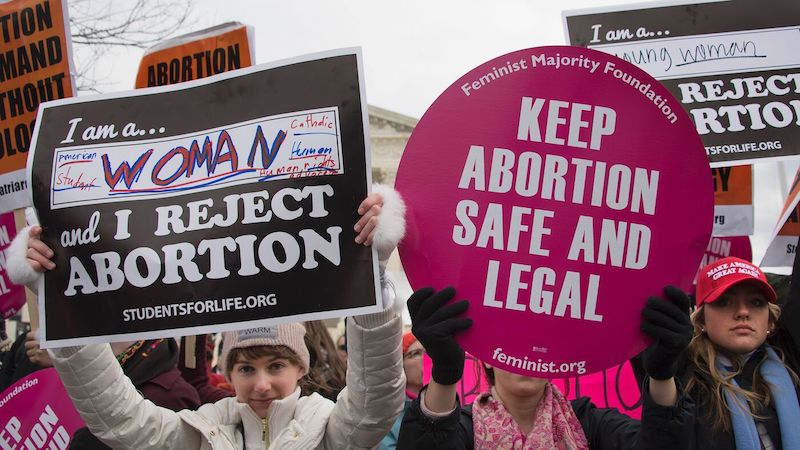
At first glance, last week’s Supreme Court decision overturning Roe v. Wade (1973) and “return[ing] the issue of abortion to the people’s elected representatives” leaves us in a fairly straightforward, if contentious, situation: Abortion will be restricted in red states and protected in blue states.
In fact, the situation is anything but straightforward. The Court’s decision in Dobbs v. Jackson Women’s Health Organization leaves unanswered several major and highly contested questions. Until these questions are answered — which could take months, maybe years — the abortion landscape will be uncertain and volatile.
In particular, the clashes between pro-life and pro-choice advocates will now be waged on at least five legal battlegrounds.
First, state constitutional law: Pro-choice advocates will use state constitutional law to challenge abortion bans.
When we talk about constitutional law, we tend to mean the law of the U.S. Constitution. But in fact, each of the fifty states has its own constitution, and many of these offer more expansive protections than their federal counterpart. And just as the U.S. Supreme Court can invalidate federal and state laws under the U.S. Constitution, state supreme courts can invalidate state laws under state constitutions.
This means that pro-choice advocates will challenge abortion bans as violating state constitutions and push for state constitutional amendments protecting abortion. (The former has already happened in Ohio, Idaho, and Kentucky, and Californians will be voting on the latter in November.)
It also means that pro-life advocates will pursue state constitutional amendments denying abortion rights and protecting fetal life. (Louisiana added such an amendment a couple years ago.)
Second, prosecutorial enforcement: Pro-choice prosecutors will refuse to enforce abortion bans.
State legislatures pass state laws, but enforcement is up to Attorneys General and District Attorneys, who have substantial discretion in deciding which cases to pursue. If a police officer has ever given you a warning instead of a speeding ticket, you’ve benefited from prosecutorial discretion.
Beyond choosing not to prosecute individual crimes, prosecutors can decline to enforce entire categories of crime, as many have done with drug possession and undocumented immigration. Prosecutors might think that pursuing such cases would be inefficient or simply unjust.
In this way, prosecutorial discretion can serve as a last line of defense for abortion rights. So pro-choice prosecutors in pro-life states will refuse to enforce abortion bans, as some have already done, effectively creating “safe haven” zones within states where abortions will be illegal in principle but permitted in practice.
Third, interstate travel: Pro-life states may try to stop women from going to other states to get abortions, and pro-choice states will fight back.
So far, no state has tried to ban women from crossing states lines to get an abortion, probably because they know courts wouldn’t allow such laws. (In a concurring opinion in Dobbs, Justice Brett Kavanaugh, the Court’s swing justice, said that interstate travel bans would be unconstitutional.)
But states might have other, more cunning options. A state could make it a crime for an out-of-state doctor to perform an abortion on one of the state’s residents, or they could target people, like drivers, who “aid and abet” women getting out-of-state abortions. (No such laws have been passed yet, but conservative lawmakers in Missouri and Texas are trying.)
Would these craftier laws be constitutional? It’s unclear. Such laws have rarely, if ever, been tested in courts; there are only two remotely relevant precedents (a 1975 First Amendment case that touched on regulating out-of-state conduct, and a 2007 Missouri Supreme Court decision that doesn’t bind other states).
And even if courts allowed them, pro-choice states would fight back. For example, prosecutors in pro-choice states could refuse to cooperate with pro-life state authorities investigating out-of-state abortions, and pro-choice state legislatures could exempt abortion providers from extradition laws.[1] (These sorts of abortion-protective laws have already been passed in California and Connecticut.)
The upshot is that pro-choice and pro-life states will conflict over who has power over what, when, and where — what some are calling the “interjurisdictional wars.”
Fourth, abortion medication: Pro-life states will try to stop women from using abortion pills, and pro-life states will fight back.
Abortion medication may be the most significant front in the abortion wars. Over half of abortions in America are carried out using abortion pills, so bans won’t accomplish much if they don’t ban the pills.
To be sure, pro-life states are trying to ban abortion medication. The “trigger laws” that have gone or will be going into effect in 13 states include abortion pills, 19 states ban using telemedicine for abortion, and Texas recently banned sending abortion pills through the mail.
But, just as with the interstate travel bans, the big questions are: Are these laws constitutional, and how will they be enforced?
Constitutionally, some scholars believe that federal law, specifically FDA regulations, preempt state bans on abortion medication. The FDA allows women to get mifepristone in the mail from a certified provider and take the pill at home via telemedicine appointment, and since federal law is supreme over state law, the argument goes, the FDA regulations prevent states from banning abortion medication use.
Practically, even if courts allowed these laws, they would face significant enforcement challenges. How will states police the mail (which is run by the federal government)? How will they prevent a black market from developing? And how will they stop women from taking abortion pills at home via telemedicine?
Overall, this issue is highly complex because it involves multiple, overlapping domains of law, and we won’t know how things will shake out until laws start getting challenged and tested in the courts.
Fifth, federal law: Congress may protect abortion — or ban it.
While Democrats control both houses of Congress, they may try to pass a law protecting abortion nationwide, in other words, codifying Roe and Casey into federal law. What would be the constitutional source of Congress’s power to protect abortion nationwide? The answer might be the Interstate Commerce Clause — tellingly, Justice Kavanaugh in his concurrence twice said that abortion is now in the hands of “the States or Congress.”
Inversely, though, if Congress has the power to protect abortion in all fifty states, it may also have the power to ban abortion in all fifty states. Of course, this wouldn’t happen while Democrats control Congress, but when Republicans eventually retake control of Washington, it might.
Some have been hopeful that by returning abortion to the states, the Supreme Court may have ended the abortion wars. In truth, legal and constitutional conflicts over abortion will persist for the foreseeable future.
[1] Note that the Constitution’s Extradition Clause applies only to people who “flee” from one state to another.
 New Frontier